
The Pathogen Papers Part 2: I Am Not the Pathogen:
Recasting "Symptoms" in the Child Survivor as Survival Skills

In the preceding chapter, we established that "Parental Alienation Syndrome" is not a valid clinical diagnosis, but a fraudulent theory used as an alibi for abusers. Dismantling that alibi, however, is only the first step. To understand the truth of what happens to a child in these toxic family systems, we must turn our forensic lens away from the flawed theory and onto the evidence itself: the child's behavior. This chapter conducts that psychological autopsy. We will demonstrate that these behaviors are not part of a "syndrome" to be diagnosed in the child, but are predictable, adaptive survival skills developed in response to the severe psychological abuse of a pathogenic parent.
Finding:
The so-called "symptoms" of Parental Alienation Syndrome are not a disorder in the child but are predictable, adaptive survival skills. A psychological autopsy of these behaviors reveals that the pathology is not a flaw in the child, but a direct result of the pathogenic parent's actions.
Analysis:
A bad investigator focuses only on the victim's reaction and ignores the perpetrator's actions. Proponents of "Parental Alienation Syndrome" follow this flawed protocol perfectly. They are fixated on a checklist of a child's so-called 'symptoms' (Gardner, 1987, p. 76), and while the full list contains eight items, they are mostly variations on three core themes of psychological survival. They show a stunning lack of curiosity about the parental behavior that created them. Let's correct that professional malpractice.
The Check List
Proponents of 'Parental Alienation Syndrome' rely on a checklist of so-called 'symptoms' in the child (Gardner, 1998, p. 76), meticulously documenting every reaction. But in their analysis, they fail to investigate the action that caused it. Let’s break down each symptom with the cause.
A bad investigator focuses only on the victim's reaction and ignores the perpetrator's actions. Proponents of 'Parental Alienation Syndrome' follow this flawed protocol perfectly. They are fixated on a checklist of a child's 'symptoms' (Gardner, 1998, p. 76), and while the full list contains eight items, they are mostly variations on three core themes of psychological survival. They show a stunning lack of curiosity about the parental behavior that created them.
Let's conduct a psychological autopsy to find the true cause of these "symptoms." This will show you that the pathology is not a flaw in the child, but a direct result of the parent's actions.
The psychological autopsy reveals the true cause of the symptoms. And when the evidence shows a parent systematically fabricating or inducing a false victim narrative in their child, the trail often leads to a severe and specific form of child psychological abuse: Factitious Disorder Imposed on Another, a pathology detailed by experts like Dr. Craig A. Childress and Dr. Alyse Price-Tobler.
Their "Symptom": Black-and-White Thinking
They claim the child irrationally vilifies one parent while idealizing the other. This is a rather simplistic view of a complex survival state. In a healthy family, a child can afford the nuance of loving two imperfect parents. In an abusive one, ambiguity is a threat. A child must simplify their world into "Safe" and "Unsafe" to stay psychologically intact. What they call "black-and-white thinking" is actually a trauma-adapted brain drawing a life-saving boundary (Herman, 2015, p. 93; Van der Kolk, 2015, p. 163). It is not a disorder; it is a defense.
Their "Symptom": Lack of Guilt or Ambivalence
They point to a child's lack of remorse for their hatred as evidence of manipulation. But guilt is a luxury you can't afford in a psychological war zone. To survive under the coercive control of a pathogenic parent, a child must fully align with that parent's reality. To feel guilt or ambivalence would create cognitive dissonance so severe it would shatter their fragile sense of safety. What they call a "lack of guilt" is actually a desperate mind protecting itself from a truth it is not yet safe enough to acknowledge (Festinger, 1957, p. 3).
Their "Symptom": Borrowed Scenarios
They argue the child's complaints are not their own, that they are simply "parroting" the parent they favor. In any high-control environment—from a cult to a pathogenic home—the victim must learn to speak the language of the controller to survive. This isn't "parroting"; it's a hostage learning what to say to appease their captor, a direct result of Thought and Information Control (Hassan, 2015, p. 38). The "borrowed scenarios" are not evidence of the child's manipulation; they are damning evidence of the parent's coercive control (Stark, 2007, p. 4). It's the language of survival in a cult of two.
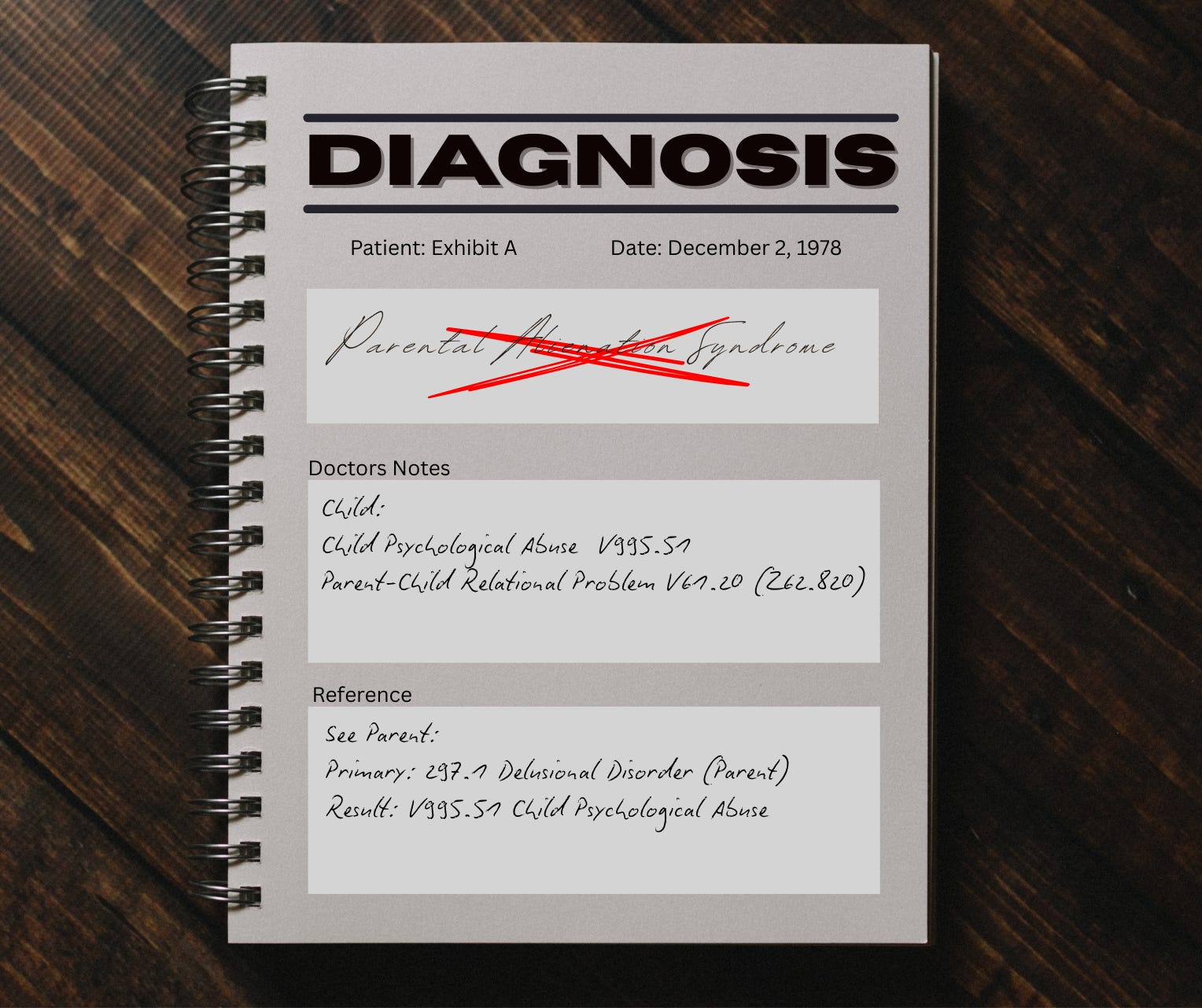
Exhibit A:
This isn't an academic exercise for me. I lived this. The absolute certainty I was taught to have, the phrases that weren't my own, the lack of guilt... I was told what to feel. I now understand this was my armor. They were the tools a child used to survive an impossible situation. They were the symptoms not of my disorder, but of my resilience.
Conclusion:
Stop looking for the pathology in the child. The child's reactions are not the illness; they are the footprints left behind by the pathogen. The evidence was never a flaw in my character; it was the echo of a crime.
And in our next installment, we're going to put that pathogen under the microscope.
Reference List
Childress, C.A. (2015) An Attachment-Based Model of Parental Alienation: Foundations. Oaksong Press
Festinger, L. (1957). A theory of cognitive dissonance. Stanford University Press.
Gardner, R. A. (1998). The parental alienation syndrome: A guide for mental health and legal professionals (2nd ed.). Creative Therapeutics.
Hassan, S. (2015). Combating cult mind control: The #1 best-selling guide to protection, rescue, and recovery from destructive cults (3rd ed.). Freedom of Mind Press.
Herman, J. L. (2015). Trauma and recovery: The aftermath of violence—from domestic abuse to political terror (2015 ed.). Basic Books.
Stark, E. (2007). Coercive control: How men entrap women in personal life. Oxford University Press.
Price-Tobler, A. (2023). Disrupting the intergenerational trauma cycle of high conflict divorce: Volume one. Inspiring Publishers.
Van der Kolk, B. A. (2015). The body keeps the score: Brain, mind, and body in the healing of trauma (2015 ed.). Penguin Books.
About the Author

Dawn McCarty is a #1 international best-selling author and award-winning cybersecurity expert who applies the rigorous principles of threat detection and risk management to the complex landscape of childhood trauma. An abduction survivor turned global advocate, her work in promoting systemic reform earned her the Catalyst for Change Award for advancing SDG #10 – Reduced Inequalities.
Dawn’s personal story—marked by abduction, grooming, and the weaponization of the Mormon religion within a dynamic of pathogenic or cult-like parenting, is the driving force behind her life's work. This lived experience, combined with over 25 years in cybersecurity and a background in cyberpsychology, gives her a rare, 360-degree understanding of both technological and human threats. She uniquely compares the breach of a child's safety to a critical security breach in a system, providing innovative strategies for threat detection, risk mitigation, and building resilience.
This synthesis of survivor insight and expert analysis is the foundation of her upcoming Unsealed Trilogy. The series begins with her gripping memoir, Sealed to My Abductor; continues with the analytical framework, Doctrine of One: The Cult of Two; and culminates in the groundbreaking clinical dissection, Anatomy of a Mind-F*ck. She is also the creator of the Digital Defense series, which equips families against cyber and AI-related threats.
Her multidisciplinary expertise is grounded in extensive academic training, with degrees in Criminal Justice (B.S. in Psychology of Victimology, M.S. in Crime Scene and Evidence Management), B.S. in Computer Science, and an MBA in Cybersecurity. As the founder of the Thrivers Speak® and Securing Everything, and co-founder of the Nothing About Us, Without Us (NAUWOU™) conference, Dawn leads the charge to protect children from online predators and toxic family dynamics, particularly those involving severe Child Psychological Abuse (CPA) linked to undue influence, child predators, pathogenic parenting, alienation, and abduction.
Through her writing, speaking, and advocacy, Dawn provides a roadmap for deconstructing trauma and creating safe, informed environments for the next generation.
Read more at the Unsealed Press
Learn more at Sealed To My Abductor
Connect with Dawn on Facebook, LinkedIn, Twitter, TikTok, or YouTube.